maandag 15 februari 2016

Part 10 - Aldehyde and Acetaldehyde

Part 10 – Aldehyde and Acetaldehyde
==================================================

v  Aldehyde
Aldehyde is an organic compound containing a  –CH=O  group. A few examples of aldehydes:


v  Acetaldehyde (or Ethanal)
The main aldehyde in wine is acetaldehyde, also called ethanal (CH3-COH). Ethanal is an intermediary of alcholic fermentation obtained by decarboxylation of pyruvate (see Part 1, step 11 or image below). Ethanal is mainly reduced to ethanol, but small quantities of it may be released into the wine. A high concentration of ethanal gives off a characteristic aroma that contributes to the perception that the wine is oxidized. Normally alcoholic fermentation produces only small amounts of ethanal (average 70 mg/L) that remains below its detection threshold (125 mg/L).    


v  Chemical oxidation
However, in the presence of oxygen, more ethanal can be formed by ethanol oxidation. For this reason, ethanal is also defined as ‘oxidized alcohol’. In the bottle, the limited oxygen oxidizes the ethanol in the wine into ethanal. This happens very slowly. It is a non-enzymatic oxidation because no enzyme is involved. It is also called a chemical oxidation. In the long run, if additional oxygen can get into the bottle (e.g. the cork dries out), ethanal will be oxidized into acetic acid, making the wine smell like vinegar and completely out of balance. This explains why an open wine can not be kept long.


v  Biological oxidation
Some wines, such as Fino and Manzanilla from Jerez, or wine Jaune from Jura, give off a particular aroma which is characterized by a high concentration of ethanal. These wines are obtained by aging the wine under aerobic conditions and under a film of flor yeasts. The flor-film protects the wine from oxidation. Since the ‘fermentation yeasts’ have consumed all the sugars, the ‘flor yeasts’ have to use the ethanol, glycerol and acetic acid in the wine and the oxygen in the air to grow. Inside the flor yeasts, the ethanol is oxidized into ethanal, catalysed by enzyme. It is a “biological oxidation”. Some of the ethanal escapes from the flor yeasts into the wine. It gives a characteristic aroma to the wine (see below the general scheme of Peinado and Mauricio). That’s what makes biological oxidation beneficial to these wines. However, in bottle, without the protection of the flor, these wines are subject to chemical oxidation as well.


v Hate and love relationship between oxygen and wine
Oxygen is not always the enemy of wine. Especially to red wine, oxygen is a friend. The polymerization (= clumping) between anthocyanin molecules and tannin molecules and the polymerization of the tannin molecules themselves needs oxygen.
The color of red wine is determined by the anthocyanin and tannin molecules.The action of oxygen during the ripening promotes this polymerization process, which takes place at tank and especially in the slightly air-permeable wooden barrels. Polymerization of tannin molecules softens the astringent taste. That explains why young tannic red wine needs aeration after opening.


---------------------------------------------------------------------------------------------------------------------------------------------------------- 

P.S.
Buttery smell was once the trademark of California Chardonnay. Responsible voor this is the 'diacetyl' . Next post we'll take a look at how it is formed.


vrijdag 15 januari 2016

Part 9 - Acetic acid

Part 9 – Acetic acid
==================================================
v Acetic acid (CH3-COOH)  is the main volatile acid in wine. Its presence at high concentrations gives off a vinegar odor and a disagreeable sensation in the mouth. Acetic acid can be produced by <1> yeasts, <2> acetic acid bacteria and <3> lactic acid bacteria.

<1>  Yeasts produce acetic acid in 2 ways : by ethanol oxidation and by acetyl-coA hydrolysis. If there are no problems during alcoholic fermentation, yeasts produce only small quantities of acetic acid (200-300 mg/L), which is far below its detection threshold (800 mg/L).


<2>   Acetic acid bacteria (AAB) ,  genus Acetobacter aceti, are aerobic, which means that they need oxygen to grow. In the presence of oxygen, they convert ethanol into  acetic acid. In proper fermentation, the AA-bacterial growth is minimum because all the oxygen is consumed by yeasts. By stuck and sluggish fermentation, they get a chance to develop. They use ethanol for their energy source to grow. The ethanol is oxidized via alcohol dehygogenase (ADH) and aldehyde dehydrogenase (ALDH) into acetic acid which comes in the wine. The removed hydrogen protons (H+) are pumped into the periplasm and come back in the cytoplasm via ATPase to form ATP. The hydrogen electronen are transported by the ubiquinol oxidase (Ox)  and finally captured by oxygen (O) which combines with 2H+  and become H2O  (see also Part 3 ETC).


<3>   Lactic acid bacteria (LAB)   found in wine belong to three genera: Leuconostoc, Lactobacillus and Pediococcus. They are anaerobic, which means they don’t need oxygen to grow. They grow on sugars and acids by converting them into lactic acid. That’s why they are called lactic acid bacteria. Like yeasts, LAB can also break down glucose in cytoplasm by glycolysis to produce 2 ATP. Yeasts reduce aldehyde to ethanol and LAB  reduce pyruvate to lactic acid. They both do that for the same purpose: to regenerate NAD+.


 Like Acetic acid bacteria, LAB live in the must, but can not grow because of the powerful yeast growth. By stuck and sluggish fermentation, they get chance to develop, especially Lactobacillus and Pediococcus, which are regarded as “bad guys”. They change pyruvate into acetic acid.


v Acetic acid  & ethyl acetate

l Acetic acid (threshold 800 mg/L) smells like vinegar. A normal wine contains 200-300 mg/L acetic acid.

l Part of the acetic acid in wine can combine with ethanol to form esters, called ethyl acetate (see Part 7)


l  Ethyl acetate (threshold 150 mg/L) smells like glues and nail polish removers.

l  In wine ethyl acetate is always accompanied by acetic acid. At a value of 150-180 mg/L of ethyl acetate combined with 700-800 mg/L of acetic acid, there is a vinegar sting (piqûre acétique). This is a wine fault, and the cause is bacterial contamination.

l  The legally permitted maximum volatile acid content (e.g. acetic acid, lactic acid and ethyl acetate)  is 1080 mg/L in  
    white wines, 1200 mg/L in red wines and 1500 mg/L in botrytis wines.

---------------------------------------------------------------------------------------------------------------------------------------------------

P.S.
In the next post, we'll take a look at the formation of acetaldehyde (or ethanal) and the difference between chemical and biological oxidation.


dinsdag 15 december 2015

Part 8 - Aerobic Biosynthesis

Part 8 - Aerobic Biosynthesis
==================================================
v  Anaerobic ande aerobic biosynthesis
Yeasts do not need oxygen to convert glucose to ethanol or to synthesize glycerols, saturated fatty acids and proteins from amino acids. However, oxygen is needed for :
                - biosynthesis of ATP in Electron Transport Chain (see Part 3),
                - biosynthesis of unsaturated fatty acids (UFA), and
                - biosynthesis of ergosterol.


v Phospholipids bilayer
A yeast cell membrane is constructed of phospholipids. A phospholipid consists of a phospho-head and two fatty acid-tails (lipid = fat ). The phospho-head is hydrophilic (love water); the fatty acid-tails are hydrophobic (fear of water).
For this reason, the yeast cell membrane is formed by a "tail-to-tail” bilayer of phospholipids. The phospholipids float against each other. They are not fixed to each other. They allow proteins and enzymes to move freely between them. At low temperature they become tightly close and at high temperature they drift loosely. The yeast cell membrane is a fluid mosaic model.


v Proteins, Carbohydrate & Sterol
The cell membrane consist of not only phospholipids, but also many other substances, which can be divided into 3 groups. (1) Different proteins, for different functions, synthesized from different amino acids. 
(2) Carbohydrate is a carbon where water is included (H-C-OH). Carbohydrate attached to protein or phospholipid is called glycoprotein resp. glycolipid. 
(3) Sterol, which is called cholesterol in animal and ergosterol in yeast.


v Unsaturated fatty acids (UFA) & medium chain fatty acids (MCFA)
The yeast cell membrane is a fluid mosaic model.The fluidity of the yeast cell membrane is considerably reduced by low temperature and high ethanol concentration. The phospholipids go tightly against each other. This can prevent cellular transport systems from functioning correctly. Therefore, during alcoholic fermentation yeasts must adapt the membrane fluidity to the changing environmental conditions. They can do that by synthesizing unsaturated fatty acids (UFA) or medium chain fatty acids (MCFA). They both have a lower melting point and more flexibility, and therefore they could modulate the membrane fluidity. Only for UFA, oxygen is required to dehydrogenate at a defined position in fatty acids 
(-CH2-CH2- + O à -CH=CH- + H2O). The enzyme, desaturase OLE1, catalyses this  dehydrogenation, and is activated by low temperatures and the presence of oxygen.


v Ergosterol
The yeast can also modulate the membrane fluidity by increasing its proportion of ergosterol. Ergosterol is a fatty substance that is located between the fatty acid tails in the  membrane. It ensures that the phospholipids are not too close together at low temperature and not too far apart at high temperature. Ergosterols (like fatty acids) are synthesized from acetyl-CoA by the mevalonate pathway. It is a very complicated pathway of about 30 steps. The key step is, without any doubt, the reaction catalysed by squalene monooxygenase which uses oxygen as a substrate to transform squalene into squalene 2.3-expoide. Without oxygen, the ergosterol synthesis will stop there.


v  Membrane fluidity adaptation during fermentation
l Red wines are fermented at relatively high temperatures (28-30oC) and are aerated in order to enhance colourextraction. High temperatures cause excessive fluidity which can alter the organization and the dynamic properties of the membrane. The increasing ethanol concentration creates a new aggressive environment. Under these conditions, the yeast must increase their proportion of UFA and ergosterols to compensate for this effect and consequently enhance their tolerance to ethanol. These changes can be done without problems because oxygen is introduced during the racking process.

l White wines are made at low temperatures (14-18oC) and without aeration to conserve aromas. The low temperature and the increasing ethanol concentration prompt the yeasts to adapt their membrane fluidity by increasing the proportion of UFA and ergosterols. However, these can not go on when the oxygen is running out. The yeasts need to use another strategy to fluidize their membranes and the only possibility is incorporating medium chain fatty acids (MCFA).

l Long-chain fatty acids (LCFA) and medium-chain fatty acids (MCFA)  can form esters with alcohols. The volatility of the esters (boiling point) is dependant on the length of the compound: generally the longer the chain, the less volatile. As we already know esters contribute aromas to wines, and these aromas will completely be gone within 1 or 2 years by hydrolysis. That explains why esters are of more significance to the young white wines than to the reds.

 ----------------------------------------------------------------------------------------------------------------------------------------------------------

P.S.
Next post we'll take a look at the acetic acid, the main volatile acid in wine.


dinsdag 17 november 2015

Part 7 - Esters

Part 7 – Esters
==================================================
v  Esters
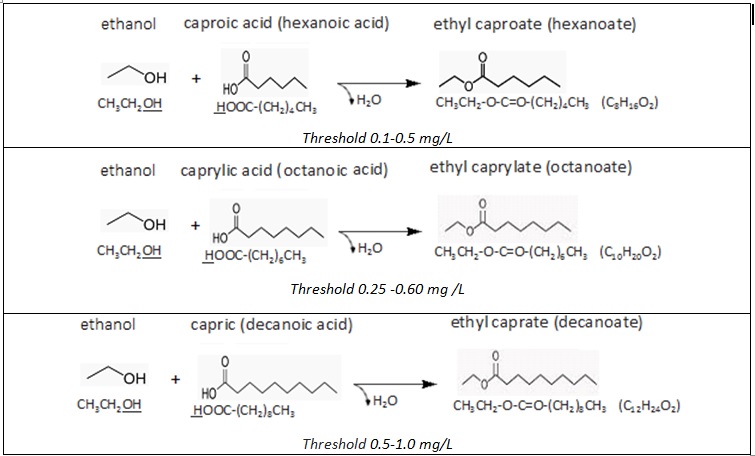
Alcohols (ethanol and high alcohols) and acids (acetic-, lactic-, fatty-, tartaric- and succinic acid) are key components in wine. These two components, alcohol and acid, can enter into a chemical reaction with each other to form a new compound. When this happens, the –OH-group of the alcohol links up with the –COOH-group of the acid, whereby H2O splits off. This is called a ‘condensation reaction’ and the new compound is called an ester.

l The esters are named as follows: the alcohol (ethanol) loses the -OH group and; the suffix-anol is replaced by -yl (e.g., ethanol à ethyl); the acid loses an H-ion and gets the suffix-ate (e.g. acetic acid à acetate).

l An ester, depending on its concentration (detection threshold), gives off an odor to wine which can be positive or negative. The volatility of the ester (boiling point) is dependent on the length of the compound: generally the longer the chain, the less volatile. Common esters in wine can be divided into 4 groups:


Group 1.  Ethanol + acetic/lactic acid
These volatile esters do not contribute positively to the wine aroma. A high content of these esters indicates wine fault.


Group 2.  Ethanol + fatty acid
Fatty acid esters give off fruity, sweets odors at low concentration, but at high concentration they may gives off a slightly unpleasant soapy, rancid-like smell.


Group 3.  High alcohol + acetic acid
High alcohol esters play an important role in the aromas of wine, especially in young white wines. In particular isobutyl acetate and isoamyl acetate, which give off odours of pear and banana. These attractive aromas dominate in many simple, industrially produced young white wines. The high content of these esters is obtained by using substantial quantities of at specific enzymes selected yeasts and cool but fast fermentation. A strong pear and banana flavor is not exactly a quality indicator. It is an aroma of transient, which usually completely disappears within 1 or 2 years by hydrolysis, making these wines quickly uninteresting.


Group 4  Diethanol + Dicarboxylic acid
Esters from group 1 – 3, are formed during fermentation. They are catalysed by enzyme and go very fast. The esters in this group, group 4,  are formed during wine aging. They are not catalysed by enzyme and  they occur very, very slowly.

Tartaric acid comes from grapes. Succinic acid is formed in the TCA cycle (see Part 2)  and have 2  carboxylic acid groups (COOH). They need 2 ethanols to form an ester. These esters, at normal concentrations, have no sensory impact.


v Detection threshold
The detection threshold is the lowest concentration of a certain compound that is perceivable by a human.
This threshold is measured through extensive testing using human subjects in laboratory settings. Detection thresholds are not exact values; not everyone is equally sensitive to a certain smell or taste. The detection threshold of a substance may be different in different literatures.


v Concentration
Scents like  musk, amber or faeces, smell unpleasant in itself, but at very low concentration, they can be an essential part of the composition of a perfume. Some compounds and esters in wine can smell pleasant at low concentration but unpleasant at high concentration. Also, not everyone is equally sensitive to certain smells. Even worse, our sensory capability is not constant, it changes depending on physical conditions like being tired or having a cold. That explains why there can be so many different odor descriptions for one and the same wine.

------------------------------------------------------------------------------------------------------------------------------------------------------------
P.S.
Esters are mainly of interest in aromas in the young white wines than in reds. Why?
In the next post we'll take a brief look at the yeast cell membrane and a number of aerobic biosyntheses to find out the reason.


zaterdag 17 oktober 2015

Part 6 - Higher alcohols

Part 6 - Higher alcohols
==================================================
v  Alcohols and Higher alcohols (or Fusel alcohols)
Alcohols are carbon compounds containing one (or more) hydroxyl groups (-OH). According to the number of carbons, they are given a name of their own, with suffix –ol.


Higher alcohols (also called fusel alcohols) are alcohols containing 3 carbons or more. Unlike ethanol, higher alcohols are not derived from glucose metabolism.  They are formed as by-products from  amino acid decomposition  and their concentration range in wine is between 100 – 500 mg/L. 

* An alcohol containing three or more hydroxyl groups (e.g. glycerol with 3 -OH groups) is called a polyol (poly = many)


v Substrates for these higher alcohols are <1> α-amino acids and <2> α-keto acids
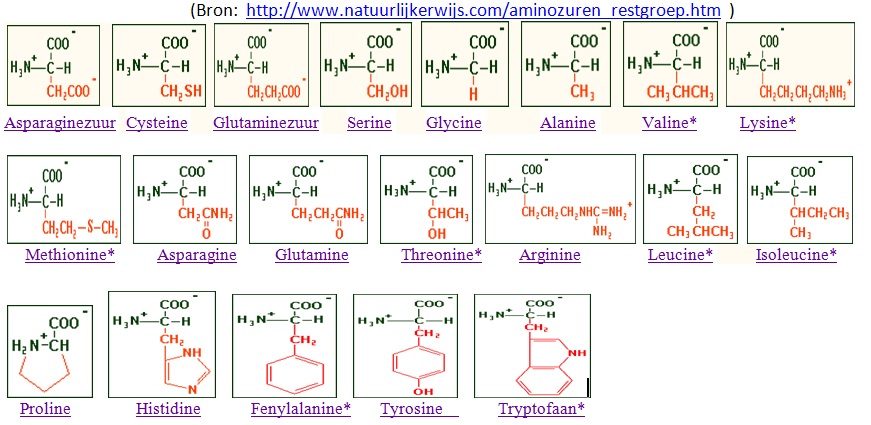
<1>  Amino acids are carbon compounds containing an amino group (NH2) and a carboxylic acid group (COOH).
At moderate pH values (e.g. in human body) the COOH can release a H to NH2 to make them NH3 and COO – (see images below). In an acidic environment, like wine, they remain generally as NH2 and COOH.
α-Amino-acids are Amino acids where the amino group (NH2) is attached to the C-atoms after the COOH-group (see Part 5, Fatty acids C-atoms numbering). α-Amino acids are in the must or added to it by the wine-maker. The yeasts need a lot of α-amino acids to build new membranes and proteins. Proteins are made from 20 different α-amino acids.


<2> Keto acids are acids with a keto-group (C=O). Keto acids where the keto-group (C=O) is situated right behind the COOH-group are called α-keto acids . There are 3 α-keto acids in yeast.


v  Higher alcohol formation
The α-amino acids composition in the must is not necessarily similar to the needs of the yeast cell. When there is a shortage of specific amino acids, yeasts can make them by exchanging the NH2-CH-group of α-amino acids and the C=O group of α-keto acids.This is called transamination, and is catalysed by the enzymes called transaminases or aminotransferases. When an α-amino acid is changed to an α-keto acid, then decarboxylated and reduced, higher alcohol is formed (see image below:  Ehrlich Pathway for higher alcohol). Note that, both alcohol and higher alcohol are formed by ‘reduction’ at the last step.


v  Main higher alcohols in wine
Quantitatively, the main higher alcohols in wine are Isobutanol (4C), Isoamylacohol or Isopentylalcohol (5C) and Phenylethanol (6C),  which are formed from α-amino acids valine, leucine, isoleucine and fenylalanine.


v  Stuck and sluggish fermentation increases higher alcohol formation
Higher alcohol formation has the same purpose as glycerol formation, namely to regenerate NAD+  in order to compensate for the NAD+ deficit caused by a stuck and sluggish fermentation.

A high content of higher alcohols gives the wine a burning, sharp, "foamy" character, to the detriment of the finesse.


v  Higher alcohosl and wine aroma
In small amounts, higher alcohols can contribute to the aromas of wine. Higher alcohols can bind with acetic acids to form esters, which are responsible for that well known pear and banana flavor,  especially in many  industrially produced young white wines  (more about esters in Part7 – Esters).


 --------------------------------------------------------------------------------------------------------------------------------------------------
P.S.
 - What are esters?
- How are they formed ?
- What  impact can they have on wine ?
Till the next post!


woensdag 16 september 2015

Part 5 - Fatty acids

Part 5  -  Fatty acids
==================================================
v Fatty acids are acids which can form fat with glycerol
Fatty acids are characterized by one methyl group (CH3) at the one end and, one carboxyl group (COOH) at the other end. In between them only carbons (C) and hydrogens (H). Three fatty acid molecules and one glycerol molecule together can form one fat molecule. This happens when the 3x COOH groups and the 3x OH groups join together and 3x H2O split off. This is called a ‘condensation reaction’.
- A fatty acid with only single bonds (-CH2-CH2-CH2-CH2-) is called a saturated fatty acid.
- A fatty acid with one or more double bonds (-CH2-CH = CH-CH2-) is called a unsaturated fatty acid.


l To clarify, pyruvic acid (CH3-CO-COOH), lactic acid (CH3-CHOH-COOH), oxaloacetic (2 –COOH groups) and citric acid (3 –COOH groups) are not fatty acids. They have a different structure and they can not form fat with glycerol.


v Fatty acid is an important component of the cell membrane.
The cell membrane is constructed of phosfolipids. A phosfolipid consists of a head and a tail of 2 fatty acids (lipid = fat ). We have seen this already in Part 4.


v  Sources fatty acids
For cell multiplication, a lot of fatty acids will be needed. For this purpose, cells may hydrolyze (=split with water) fat into glycerol and fatty acids. Usually cells synthesize fatty acids from Acetyl-CoA. Cells can obtain Acetyl-CoA in many ways, e.g.
(1) from glucose (see glucose metabolism).
(2) from citric acid in the must (grape juice), which will be converted in oxaloacetic acid and acetic acid. The acetic acid will then be attached to coenzyme A to become Acetyl-CoA.
(3) from amino acids (see image below) and proteins which are basically made up of amino acids.  Must poor of amino acids or proteins (e.g. by excessive ‘débourbage’) may have problems to start the fermentation.


v  Fatty acid synthesis from Acetyl-CoA in cytoplasm.


l In order to synthesize fatty acids, Acetyl-CoA will first replace  the coenzyme CoA with the ACP (acyl carrier protein). Acetyl-CoA has become Acetyl-ACP. This Acetyl-ACP will be carboxylated to become Malony-ACP and the synthesis can begin.

l The synthesis occurs in 4 steps. (1) The Malonyl-ACP will be decarboxylated, then linked up with a 2nd Acetyl-ACP by releasing H-S-ACP. They become an Acetoacetyl-ACP. This will then be (2) reduced, (3) dehydrated and (4) reduced, resulting in a  4-carbon compound, Butyryl-ACP. When this is linked up with a 3rd Acetyl-ACP, these 4 steps will be repeated, with the difference that there is no decarboxylation in the first step. Each addition of a new Acetyl-ACP will make the ACP-compound  2 carbons longer. When the ACP is hydrolyzed (=split with water) it becomes a fatty acid.

l In general, NADP and NADPH are used in anabolism (building reactions, such as fatty acid synthesis), while NAD and NADH are used in catabolism (breaking reactions, such as glycolysis).


v Fatty acid chains
Fatty acid chains differ by length. The smallest fatty acid, with 3 carbon atoms, is called propionic acid. Animal fatty acids usually contain a long and an even number of C-atoms (almost always 14 -24).
Fatty acid chains are often categorized as short to very long.
- Short-chain fatty acids (SCFA) are fatty acids with less than 6 carbons. 
- Medium-chain fatty acids (MCFA) are fatty acids with 6 to 12  carbons.
- Long-chain fatty acids (LCFA) are fatty acids with 13 to 21 carbons.
- Very long chain fatty acids (VLCFA) are fatty acids with more than 22 carbons.


v  Diagrammatic representation of a long fatty acid


v  Fatty acids C-atoms numbering
The C-atoms of the fatty acids are numbered starting at the C-atom of the-COOH group. The C-atoms 2 and 3 are often indicated by α and β. The C-atom of the methyl group at the end of the chain is called the omega (Ѡ).


v  Saturated or unsaturated fatty acids? Long or medium chain fatty acids?
Saturated fatty acids (SFA), as it shows in fatty acids synthesis above, do not need oxygen. They have only single bonds 
(-CH2-CH2-)

For unsaturated fatty acids (UFA), however, oxygen is needed to dehydrogenate at a defined position in the SFA (-CH2-CH2- + O à -CH=CH- + H2O). Due to the double bond, UFA has a lower melting point and is more flexibility than SFA.

During alcoholic fermentation, the ethanol concentration increases progressively which reduces drastically the fluidity of the cell membrane. The yeasts need to adapt their cell membrane fluidity by increasing the proportion of UFA in the phospholipids. In red wines, these changes can be done without problems because oxygen is introduced during the racking process. In white wines which are usually made without aeration, the lack of oxygen makes yeasts unable to synthesize UFA. Consequently, yeasts need to use another strategy to fluidize their cell membranes by  synthesizing medium chain fatty acids (MCFA). The effect of a short chain is similar to that of the double bond of a long chain.


v  Fatty acids and wine aroma
Fatty acid can bind with ethanol to form an ester. Fatty acid esters, depending on concentration, can contribute to the aromas of wine, especially in young white wines (more about esters in Part7 – Esters).


 -------------------------------------------------------------------------------------------------------------------------------------------------------

P.S.
- What are amino acids?
- What are higher alcohols? How are they formed?  And why are they formed?
These will be set out in Part 6, coming next month.


zaterdag 15 augustus 2015

Part 4 - Glycerol synthesis

Part 4 - Glycerol synthesis
==================================================
v Glycerol (CH2OH-CHOH-CH2OH or C3H8O3 )
Glycerol is the third major component of dry wines (after water and ethanol). Glycerol is a liquid with a high viscosity. When you swirl the glass, you can see the wine legs or tears which are caused by glycerol and ethanol. Glycerol and ethanol contribute body and sweetness to wine. In chemistry ethanol is an alcohol with 1 –OH group, glycerol is an alcohol with 3 –OH groups. Another name for glycerol is 1,2,3-propanetriol (triol = 3 -OH groups).
Glycerol is typically found at concentrations of 4 -10 g/L in dry wine and in the case of the botrysized late harvest wines, levels in excess of 20 g/L are not uncommon (Ribéreau-Gayon et al., 1998).


 v Glucose à 4%  GAP + 96 %  DHAP
Glucose, a 6-carbon molecule, after phosphorylation, is split into two 3-carbon molecules of different structures: glyceraldehyde-3-phosphate (GAP) and dihydroxyacetone phosphate (DHAP), but at a ratio of 4%  to 96%. The reason will be clear if we take a look at the structure of the yeast cell membrane.


The cell membrane is constructed of phospholipid. A phospholipid consists of a head of glycerol 3-p with a choline and a tail of 2 fatty acids (lipid = fat ). See image above.

In the beginning of the fermemtation a lot of glycerol 3-p will be needed for cell growth and multiplication. For this purpose the DHAP will be reduced to glycerol 3-p. Hence the 96 %. See image below. 

Two –OH groups (of glycerol 3-p) link up with two fatty acids and one –OH group (of the phosphate group) links up with a choline. Thus a phospholipid is formed. See right image above.


v  DHAP  à GAP --> --> --> -->  ethanol 
When oxygen is running out, cell growth will slow down. DHAP will be transformed to GAP (step 5) and then to ethanol (steps 6 to 12). This is done for one purpose: to regenerate NAD, so it can be used again for step 6.


v  DHAP à Glycerol 3-P  à  Glycerol
A very small amount of DHAP may be transformed to glycerol 3-p and then to glycerol during alcoholic fermentation.


Glycerol formation will be increased when sulphite (or sulfite) is formed during the fermentation. Sulphite combines with acetaldehyde which then prevents NAD from regenerating. In this case extra DHAP will be reduced in order to compensate for the NAD deficit. The glycerol 3-p will then be dephosphorylated to become glycerol. That is why addition of sulphite will lead to more glycerol formation.


________________________________________________________________________________________________

P.S.
Quiz: Why do botrysized late harvest wines, like Sauternes and Vin Jaune, have much higher glycerol content than dry wines?

Coming next month, in Part 5, we’ll see what fatty acids are, their formation and their influence on wine.